MonacoEditor
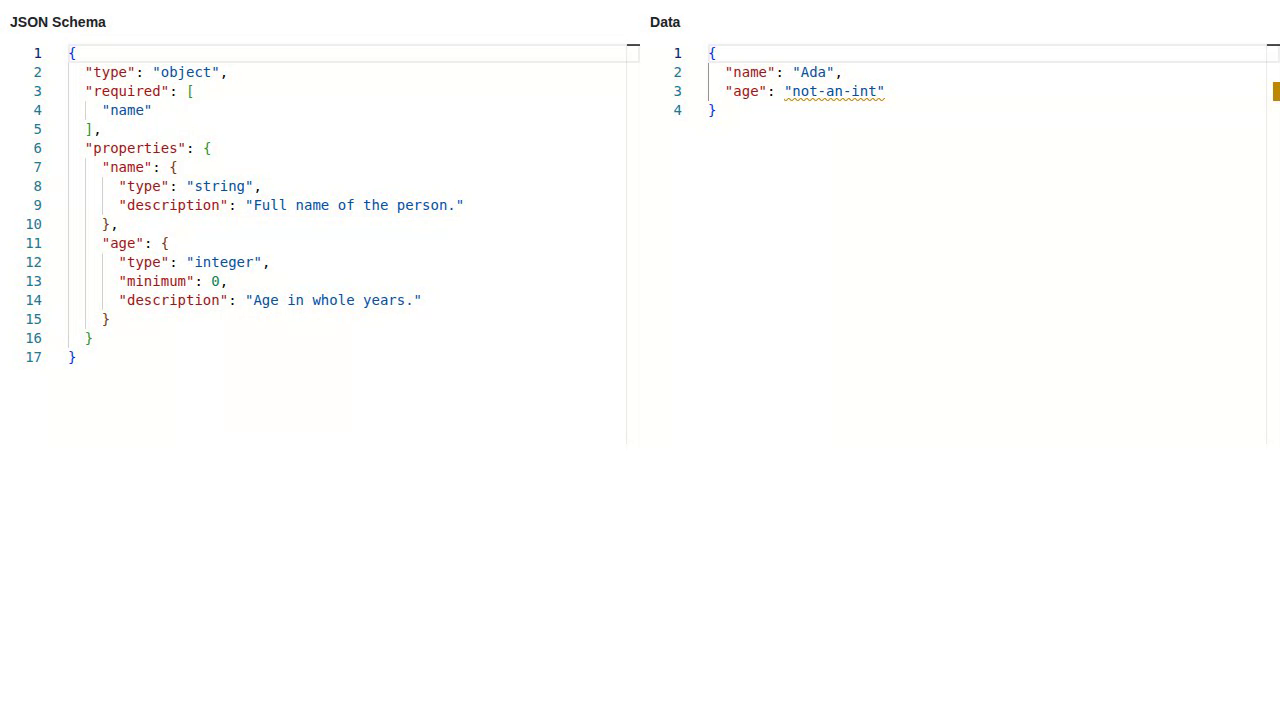
The MonacoEditor panel provides a code and JSON editor, wrapping the monaco-editor library that powers VS Code.
Overview
MonacoEditor edits text in the browser and syncs it back to Python through the value parameter. For JSON documents it adds live schema validation, hover descriptions, and completion, all resolved locally: Monaco never fetches a schema over the network unless you opt in.
Usage
Construct an editor with value (the initial text) and, for JSON documents, json_schema to validate against; language defaults to json. Read and write the buffer as text through the value parameter, or as a Python object with get_json() and set_json(). The side-by-side example is a runnable app built from these parameters.
Schema validation
Pass json_schema to validate the buffer live. Violations surface as Monaco markers (warnings for schema breaches, errors for invalid JSON) with the schema’s own description text in the hover. Assigning a new dict to json_schema re-validates immediately, so a schema editor can drive what a data editor flags.
Buffer-declared $schema
A document that declares its own $schema bypasses json_schema entirely. Because Monaco resolves nothing over the network, that pointer is normally reported as unresolvable. Three parameters control what happens:
schema_store- schemas keyed by the URI a buffer’s$schemamay name, resolved locally. Register a schema here to validate a document that points at it.schema_request- severity for the unresolvable-pointer complaint:"warning"(default),"error", or"ignore". Use"ignore"to show a document exactly as authored.enable_schema_request- let Monaco fetch schemas over the network instead (CORS permitting).
These settings are page-wide. For schema_request and enable_schema_request Monaco keeps a single value per page, so the most permissive setting among the editors wins; schema_store is shared per page too, but keyed, so the last editor to register a given URI wins.
Bundle delivery
Monaco is a large bundle. By default each editor ships a tiny shim and the browser fetches the shared bundle once from a CDN. Set the PANELINI_MONACO_BUNDLE environment variable to override this:
a self-hosted URL to the
monacoeditor.mjsmodule, or"inline"to embed the module text in the document for fully offline use.
Inlining costs one full copy of the bundle per editor instance, so it suits offline or single-editor pages rather than a page carrying many editors.
See also
Schema and data side by side - a schema and its data side by side, with live validation
Validate against an OO-LD schema - validate a document against an OO-LD schema pulled from a registry
API Reference
See the full API documentation: panelini.panels.monacoeditor.monacoeditor.MonacoEditor